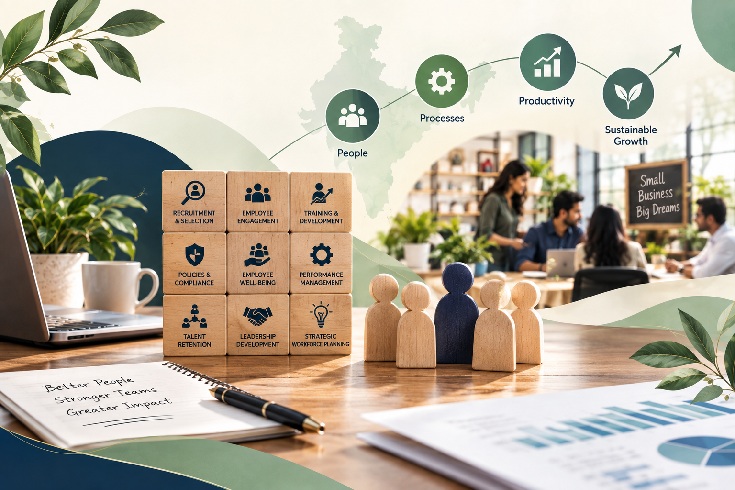
When we talk about Indian SMEs, we often make the mistake of treating them as one large, uniform group. They are anything but that. India's small business landscape is incredibly diverse. At one end are formally registered MSMEs under the Udyam framework, and at the other is the vast world of unincorporated enterprises captured through the Annual Survey of Unincorporated Sector Enterprises (ASUSE).
Looking at SMEs through both these lenses gives us a far more realistic understanding of the sector and the evolving role of Human Resource Management in Indian SMEs.
Understanding the Indian SME Landscape
The official MSME classification is straightforward. Micro enterprises have investments of up to ₹1 crore and turnover up to ₹5 crore. Small enterprises can invest up to ₹10 crore with turnover up to ₹50 crore, while medium enterprises can invest up to ₹50 crore and have turnover up to ₹250 crore. Yet, despite these formal definitions, India's MSME ecosystem remains overwhelmingly dominated by micro enterprises.
Equally important is the fact that a large share of businesses still operate in the unincorporated economy, often with limited formal registration and varying levels of compliance. This diversity has a direct impact on how businesses approach human resources in SMEs, including recruitment, employee development, compliance, and workforce management.
The Changing Role of HR in Indian SMEs
For years, HR in small businesses was viewed primarily as a recruitment and retention function. That perspective no longer reflects reality. Today, HR in Indian SMEs sits at the centre of multiple business challenges.
Human Resource Management is increasingly influenced by digital transformation, persistent skill shortages, changing labour laws, expanding social security, the rise of gig and contract work, employee mental health, gender-related caregiving responsibilities, and the capabilities of owner-managers.
Add to this the significant differences across states, industries, and business clusters, and it becomes evident that HR management in Indian SMEs is far more complex than it appears on the surface.
Key HR Challenges Faced by Indian SMEs
The evidence consistently supports this picture. Reports from government agencies and industry bodies repeatedly identify a familiar set of concerns—limited access to finance, increasing competition, technology adoption, regulatory compliance, infrastructure gaps, delayed payments, labour shortages, and difficulties in finding skilled employees.
From an HR perspective, these challenges directly affect an SME's ability to attract, develop, and retain employees. Skill shortages, in particular, can limit productivity and make business expansion more difficult.
At the same time, there are encouraging signs of progress. Digital adoption is steadily increasing, internet usage among unincorporated enterprises continues to grow, and initiatives such as e-Shram and the evolving Social Security Code are gradually extending social security benefits to workers in the unorganized, gig, and platform economy.
Skill Shortages and Workforce Management
One study that particularly stands out is the SIDBI–CRISIL survey of more than 2,000 entrepreneurs across India. The findings paint a clear picture of the pressures faced by SMEs.
Entrepreneurs consistently ranked access to credit, market competition, technology adoption, compliance requirements, infrastructure deficiencies, delayed payments, labour availability, and market access among their biggest challenges. Across several industries, nearly one in four MSMEs also identified the shortage of skilled workers as a significant operational concern.
For Human Resource Management in Indian SMEs, this highlights the importance of effective workforce planning, employee training, skill development, and retention strategies.
How Business Challenges Affect HR
What makes these findings especially interesting from an HR perspective is that these problems rarely occur independently; they are deeply interconnected.
A business struggling with limited finances is less likely to invest in digital technologies. Without digital systems, recruitment becomes less efficient, employee development suffers, and productivity remains stagnant.
Delayed customer payments reduce payroll flexibility, making it harder to invest in employee welfare, learning, and retention. Narrow profit margins often push firms towards contract or informal employment, while complex regulatory requirements influence decisions about formal hiring, outsourcing, or even remaining below statutory thresholds.
This shows why Human Resource Management for SMEs cannot be viewed separately from broader business strategy. Financial, operational, technological, and workforce decisions are closely connected.
HR Challenges During SME Growth
Perhaps the most revealing insight comes from looking at businesses as they grow. The SIDBI analysis suggests that enterprises moving from the small to the medium category often face the greatest challenges.
Growth brings new statutory obligations, governance expectations, and compliance requirements, yet many businesses are simply not prepared for this transition. This is where HR becomes much more than an administrative function.
As SMEs grow, they need stronger systems for recruitment, employee performance, training, compliance, workforce planning, and organisational development. Building these capabilities early can help businesses manage growth more effectively.
Why Human Resource Management Matters for Indian SMEs
Many of the challenges we label as "business problems" are HR problems in disguise. Weak HR capability limits organisational growth, while financial and operational constraints prevent firms from investing in better people practices.
The result is a vicious cycle: business limitations weaken HR systems, and underdeveloped HR practices, in turn, reduce productivity, innovation, employee capability, and long-term business performance.
Understanding this interconnectedness is perhaps the most important lesson for anyone studying or managing HR in Indian SMEs.
Improving HR is not merely about hiring better people or reducing employee turnover. It is about building organisational capability that enables businesses to survive, grow, and compete in an increasingly complex economic environment.
For Indian SMEs, effective Human Resource Management is therefore becoming an essential part of sustainable business growth rather than simply an administrative function.
FAQ
1. What is Human Resource Management in Indian SMEs?
Human Resource Management in Indian SMEs involves managing recruitment, employee development, retention, workforce planning, compliance, and other people-related functions within small and medium-sized businesses.
2. What are the major HR challenges faced by Indian SMEs?
Some major HR challenges faced by Indian SMEs include skilled worker shortages, employee retention, limited HR capabilities, labour compliance, workforce planning, and limited resources for employee training and development.
3. Why is HR important for SMEs in India?
HR is important for SMEs because effective people management can improve productivity, employee capability, retention, compliance, and an organisation's ability to manage and sustain business growth.
4. How does skill shortage affect Indian SMEs?
Skill shortages can make it difficult for SMEs to recruit suitable employees, maintain productivity, adopt new technologies, and expand their operations effectively.
5. How does HR change as an SME grows?
As an SME grows, HR typically becomes more structured and strategic. Businesses may need stronger systems for recruitment, performance management, employee development, compliance, workforce planning, and organisational growth.