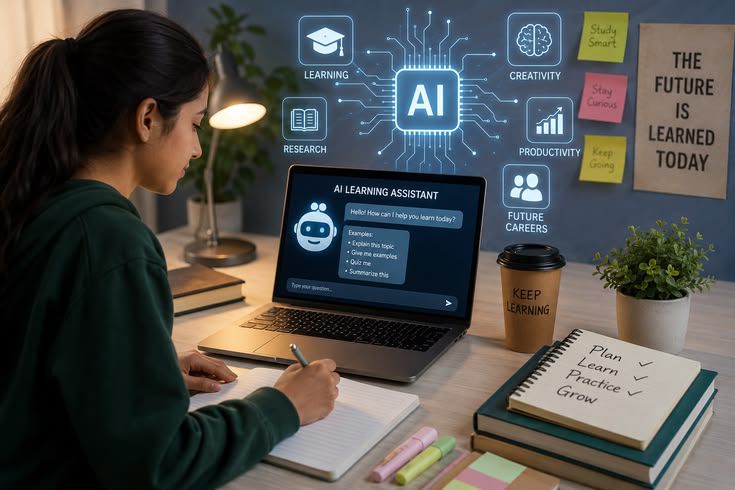
Artificial Intelligence (AI) is no longer a vision of the future. It has become a part of our daily lives, transforming how we work, communicate and make decisions. From personalised recommendations on streaming platforms to smart virtual assistants, AI is changing the way we interact with technology.
This technological revolution is also transforming MBA education and business management. As businesses increasingly adopt AI, MBA programmes are helping students develop the knowledge and skills required to become effective leaders in a rapidly changing business environment.
AI in MBA Education: Creating a More Personalised Learning Experience
AI is making the MBA classroom more interactive and creating a more customised learning experience. Gone are the days when students were limited to textbooks and traditional lectures. Today, students can use AI-based learning platforms that are designed to support different learning styles.
These tools can provide immediate feedback, recommend additional learning resources and help students understand complex business concepts. AI can therefore complement traditional MBA education by making learning more engaging, accessible and personalised.
Using AI for Data Analysis and Business Decision-Making
MBA students are increasingly being trained to use AI tools for big data analysis, market trend identification, customer behaviour prediction and financial risk evaluation.
AI can reduce the time spent on data collection and organisation, allowing students and business professionals to focus more on interpreting information and developing strategic solutions. Working with AI and data-driven tools also helps MBA students develop critical thinking and problem-solving skills that are essential for modern business leadership.
How AI Is Changing Business Management
AI is also changing the way businesses are managed. Organisations use AI to automate repetitive tasks such as inventory management, customer support, scheduling and financial reporting.
By allowing AI to handle routine activities, managers can spend more time focusing on innovation, strategic planning and employee development. This can help businesses improve efficiency, productivity and competitiveness in an increasingly digital marketplace.
For MBA students, understanding the role of AI in business management is becoming increasingly important. Knowledge of AI can help future managers identify opportunities to improve business processes and make more informed decisions.
The Role of AI in Marketing
Marketing is another area where AI is making a significant difference. Businesses can use AI and analytics to gain a better understanding of customer preferences, purchasing behaviour and online activities.
With AI-powered analytics, organisations can develop more personalised marketing campaigns, improve customer experiences and identify opportunities to increase sales. MBA students who understand these technologies can use data-driven insights to develop effective marketing strategies for the digital economy.
Why Human Skills Still Matter in an AI-Driven Business World
Although AI offers many advantages, it cannot replace essential human skills. Successful managers still need creativity, emotional intelligence, ethical judgement, leadership and communication skills.
AI can provide valuable insights and automate processes, but it cannot fully understand human emotions, build relationships based on trust or motivate teams in the same way as a human leader.
Therefore, modern MBA programmes are increasingly focused on combining technical knowledge with soft skills. This balanced approach can help develop well-rounded business professionals who are prepared to work effectively alongside AI technologies.
AI Ethics and Responsible Business Leadership
The growing use of AI also raises important ethical concerns. Issues such as
MBA students need to understand not only how to use AI effectively but also how to ensure that technology is applied fairly, transparently and responsibly. Future business leaders will have an important role in establishing ethical practices and building trust as organisations become more dependent on AI.
The Future of AI in MBA Education
AI is changing both the way MBA students learn and the way businesses operate. From personalised education and data analysis to marketing, automation and strategic decision-making, AI is becoming an important part of modern business.
However, the future of business management will not depend on technology alone. The most effective leaders will be those who can combine AI knowledge with critical thinking, creativity, communication, ethical judgement and leadership skills.
As AI continues to evolve, MBA education will play an important role in preparing future managers and entrepreneurs to use technology responsibly and make better business decisions in a digital economy.
Frequently Asked Questions
1. How is AI transforming MBA education?
AI is transforming MBA education by providing personalised learning, supporting data analysis, offering immediate feedback and helping students understand complex business concepts through AI-powered tools.
2. Why is AI important for MBA students?
AI is important for MBA students because businesses increasingly use it for data analysis, marketing, automation, customer insights and decision-making. Understanding AI can help students prepare for modern management roles.
3. How is AI used in business management?
AI is used in business management to automate repetitive tasks, analyse data, identify market trends, predict customer behaviour, manage inventory and support financial and strategic decision-making.
4. Can AI replace human skills in business management?
No. AI can automate processes and provide valuable insights, but skills such as leadership, creativity, emotional intelligence, communication and ethical judgement remain important for successful business management.
5. What are the ethical concerns related to AI in business?
Major ethical concerns include data privacy, algorithmic bias, transparency and responsible AI usage. Business leaders need to ensure that AI is used fairly, responsibly and ethically.